


 September 16, 2026
 Synergetic
 Helpful Information
If someone on your production team says, “We’ll put the lectern downstage left,” do you know exactly where they mean?
If not, you are not alone. Stage directions can feel backward until someone explains whose point of view they are based on. Once you understand that one rule—and why we say upstage and downstage—the whole thing becomes much easier.
Here is the simple version: stage directions are given from the perspective of a person standing onstage and facing the audience.
That means stage left is the presenter’s left, stage right is the presenter’s right, and those directions do not change based on where anyone else is standing.
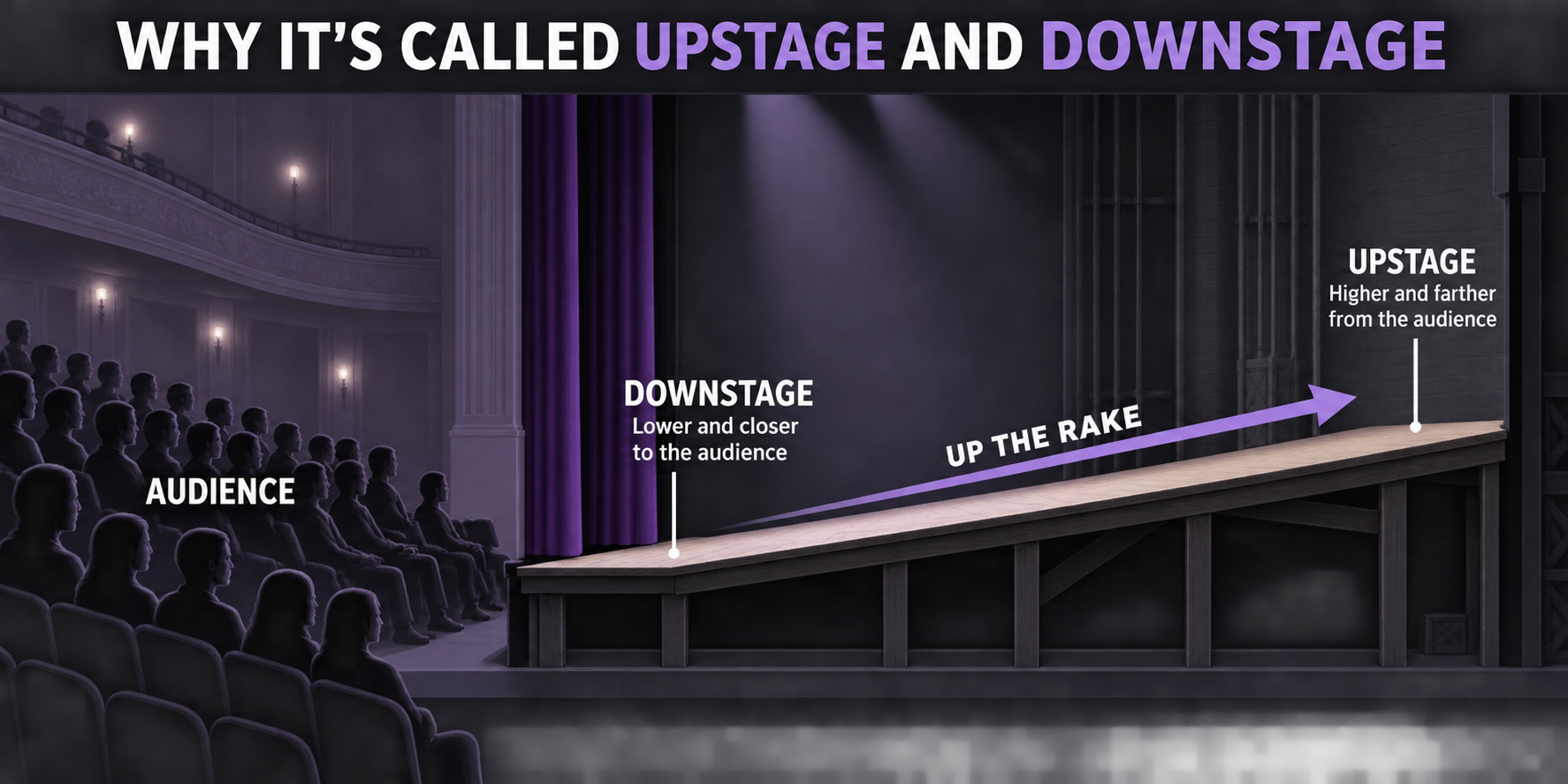
Why Is It Called Upstage and Downstage?
The terms come from older theaters with raked stages. These stages were built on a slight incline: the back of the stage was physically higher than the front.
So, when a performer moved away from the audience and toward the back wall, they were walking up the slope—or upstage. When they moved toward the audience, they were walking down the slope—or downstage.
Most event stages today are flat, but the terminology stayed.
- Upstage means toward the back of the stage, away from the audience.
- Downstage means toward the front edge of the stage, closer to the audience.
An easy way to remember it is: downstage is down by the audience.
Stage Left and Stage Right
Stage left and stage right are always based on the viewpoint of the person onstage facing the audience.
- Stage left is the performer’s left.
- Stage right is the performer’s right.
For someone sitting in the audience, those directions look reversed. When you face the stage from the ballroom floor, stage left is on your right, and stage right is on your left.
The easiest memory trick is to picture yourself as the keynote speaker. Walk onto the stage, face the audience, and use your own left and right hands. Those are stage left and stage right.
Most importantly, stage directions do not change when you turn around. They remain tied to the performer-facing-the-audience viewpoint so the entire team has one shared reference.
What About House Left and House Right?
The “house” is the audience area. House directions are given from the audience’s perspective while facing the stage.
- House left is the audience’s left.
- House right is the audience’s right.
This means house left and stage right refer to the same side of the room. Likewise, house right and stage left refer to the same side.
| Audience perspective | Stage perspective | Same physical side? |
| House left | Stage right | Yes |
| House right | Stage left | Yes |
Why use both systems? Because they help different teams communicate naturally. A producer may place a confidence monitor at downstage left, while an usher directs attendees to house left. Both descriptions can be correct; they simply use different viewpoints.
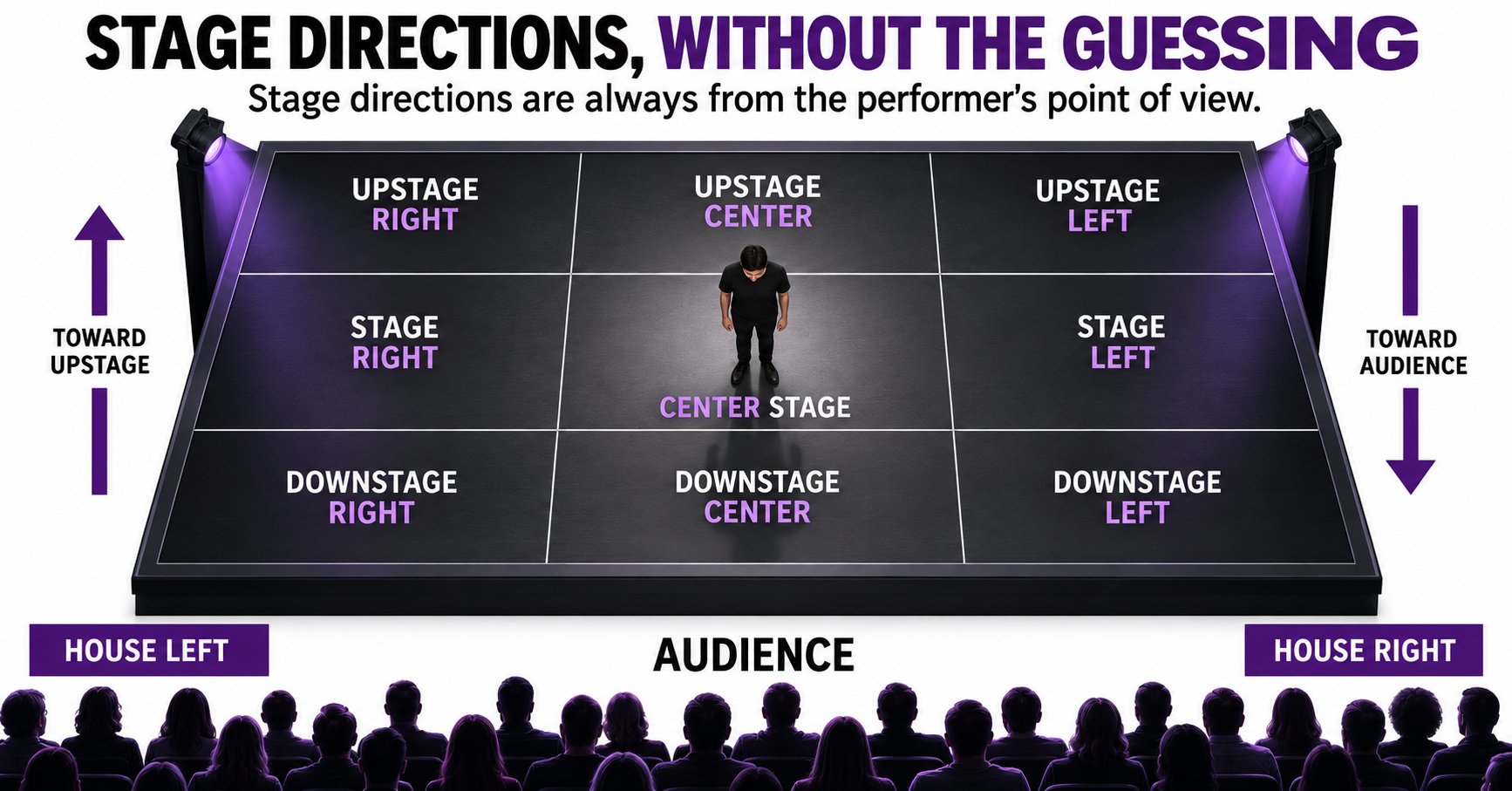
Putting the Terms Together
The stage can be divided into a simple three-by-three grid. Combine front-to-back and side-to-side directions to identify a specific area.
For example:
- Upstage right means toward the back of the stage and to the performer’s right. From the audience, this is the back-left area of the stage.
- Downstage left means near the audience and to the performer’s left. From the audience, this is the front-right area of the stage.
- Upstage center means near the back wall and centered.
- Downstage center means near the audience and centered—often where a presenter stands for the strongest connection with the room.
- Center stage means the middle of the performance area.
Here are some ways the terms might be used during an event:
“Let’s place the lectern downstage left.”
“The panelists will enter from stage right.”
“We need the scenic logo centered upstage.”
“Put the confidence monitor downstage right, angled toward the presenter.”
“The sponsor’s tables are located house left.”
Each instruction gives the event team a fixed location without anyone needing to point and say, “Over there.”
Five Ways to Remember Stage Directions
- Start with the performer. Stage left and right belong to the person onstage facing the audience.
- Downstage is down by the audience. That makes upstage the area away from them.
- House directions belong to the audience. Sit in a chair and face the stage: your left is house left.
- Stage and house directions are opposites. Stage right equals house left; stage left equals house right.
- Use the full term. “Put it on the left” invites confusion. “Put it downstage left” gives everyone the same location.
One Important Tip for Event Planners
Include stage directions on floor plans, run-of-show documents, speaker notes, and production schedules whenever location matters. If a presenter enters from stage right, a lectern sits downstage left, and a scenic element belongs upstage center, write those exact terms into the plan.
Clear directions are especially helpful in ballrooms, where one person may be looking toward the stage while another is standing on it. Using consistent terminology reduces last-minute confusion and helps speakers, planners, stage managers, and A/V teams move faster.
The 10-Second Recap
- Upstage: away from the audience
- Downstage: toward the audience
- Stage left/right: the performer’s left/right while facing the audience
- House left/right: the audience’s left/right while facing the stage
- Stage right = house left
- Stage left = house right
Once you know whose viewpoint you are using, stage directions stop sounding like theater jargon and start doing exactly what they are supposed to do: helping everyone understand where things need to go.
At Synergetic, we believe the best events happen when everyone is speaking the same language before show day. It is one more way we help our clients stay prepared, avoid surprises, and create an event they can be proud of.
 September 2, 2026
 Synergetic
 Uncategorized